The Challenge: Defining the Project Scope
As a web designer, my biggest challenge today is to become a better, more complete professional. Artificial intelligence has completely changed how we create things. Now, you can use a simple prompt to create good posters, images, layouts, and even code. The standard for professionals is getting higher, and just having years of experience or a good portfolio is not enough anymore.
This shows an important truth about the market: "experience must now go with adaptability". The world is changing very fast, and we have many AI tools that can help us grow, as long as we are ready to keep learning.
My journey started when I decided to explore and try out different AI tools. This led me to Manus.im — an advanced AI platform that is more than just a standard chat model like ChatGPT. It has special features, like being able to read web links and open compressed files (ZIP). This makes it a very powerful tool for quick testing and research.
This feature—the ability to work with live content and create web applications—opened up many possibilities, especially for web designers who want to test, research, or build prototypes using real data. It became the starting point for my project.
My goal was clear: I wanted to show how AI can be used in a practical way to solve real problems, not just talk about it.
The Idea: Finding a Problem and Solving It
I started thinking of ideas for a project that would mix my professional skills with a personal interest. My recent hobby, Magic: The Gathering (MTG), a card game known for its complexity and huge number of cards, was the perfect subject.
As a new player (less than two years), I quickly found problems that AI could solve. These ranged from understanding how to build a good deck to competing against experienced players with optimized strategies.
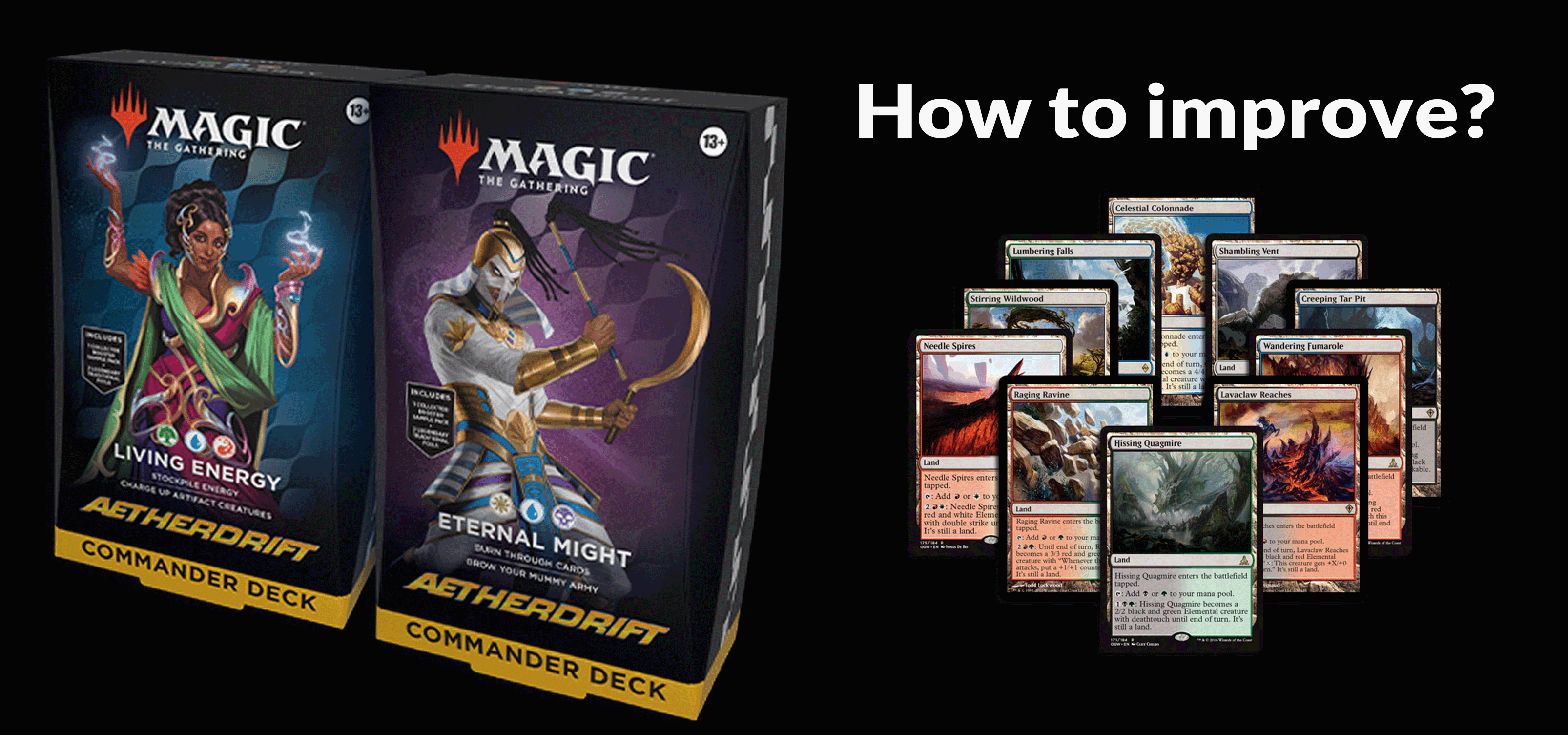
The main problem was making decks better. While pre-built decks ("precons") are fine for casual games, they are often too weak for more competitive games. With thousands of cards available, each with different effects and changing prices, it takes a lot of time and effort to manually find the best card combinations. My goal was to improve a deck focused on a specific strategy without spending hours on research.
This is where I saw the potential of AI. I realized I could use AI to create a tool for deck analysis. This tool would use data analysis, smart thinking, and automation to help players like me make better choices when choosing cards to improve their deck's value and strength.
The AI-Driven Development Cycle: Plan, Build, and Check
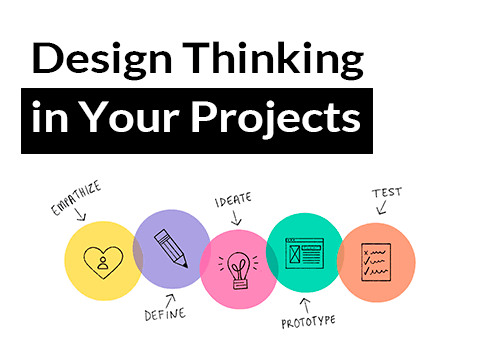
To turn my idea into a real solution, I used a fast, AI-powered development cycle that follows the main ideas of the Lean method: Structure, Learn, Test, and Improve. This approach helped me avoid the usual slow parts of development and quickly create a working prototype.
1. Structure: Defining the Minimum Viable Product (MVP)
The first important step was to turn the complex problem—improving a Magic: The Gathering Commander deck—into a clear, simple instruction (a prompt) for the AI. This meant defining the AI's role, what I wanted it to produce, and the rules it had to follow.
The goal was to create a Minimum Viable Product (MVP): a simple website that takes a decklist and gives back a professional analysis and suggestions for new cards.
The prompt acted as the detailed plan for the AI developer:
AI Prompt (Simplified - The Plan):
Role: You are an expert in Magic: The Gathering Commander.
Task: Analyze this deck and generate:
General analysis (strategy, how cards work together, weaknesses).
A list of cards to remove (the same number as those to add).
A list of cards to add (use scryfall.com as a source).
A section that groups cards by type (Creatures, Enchantments, etc.).
Rules:
• Keep the total number of cards at 100.
• Use cards from Scryfall first.
• Do not suggest the same card twice.
• Make sure the number of cards removed and added is equal.
2. Learn: Using AI as a Complete Development Partner
The AI's response was fast and surprising.
Instead of just giving me text, Manus.im understood the request as a command to build a working application. It gave me a live link.
Click here: https://mtgdeckopt-bo4pcqmo.manus.space/.
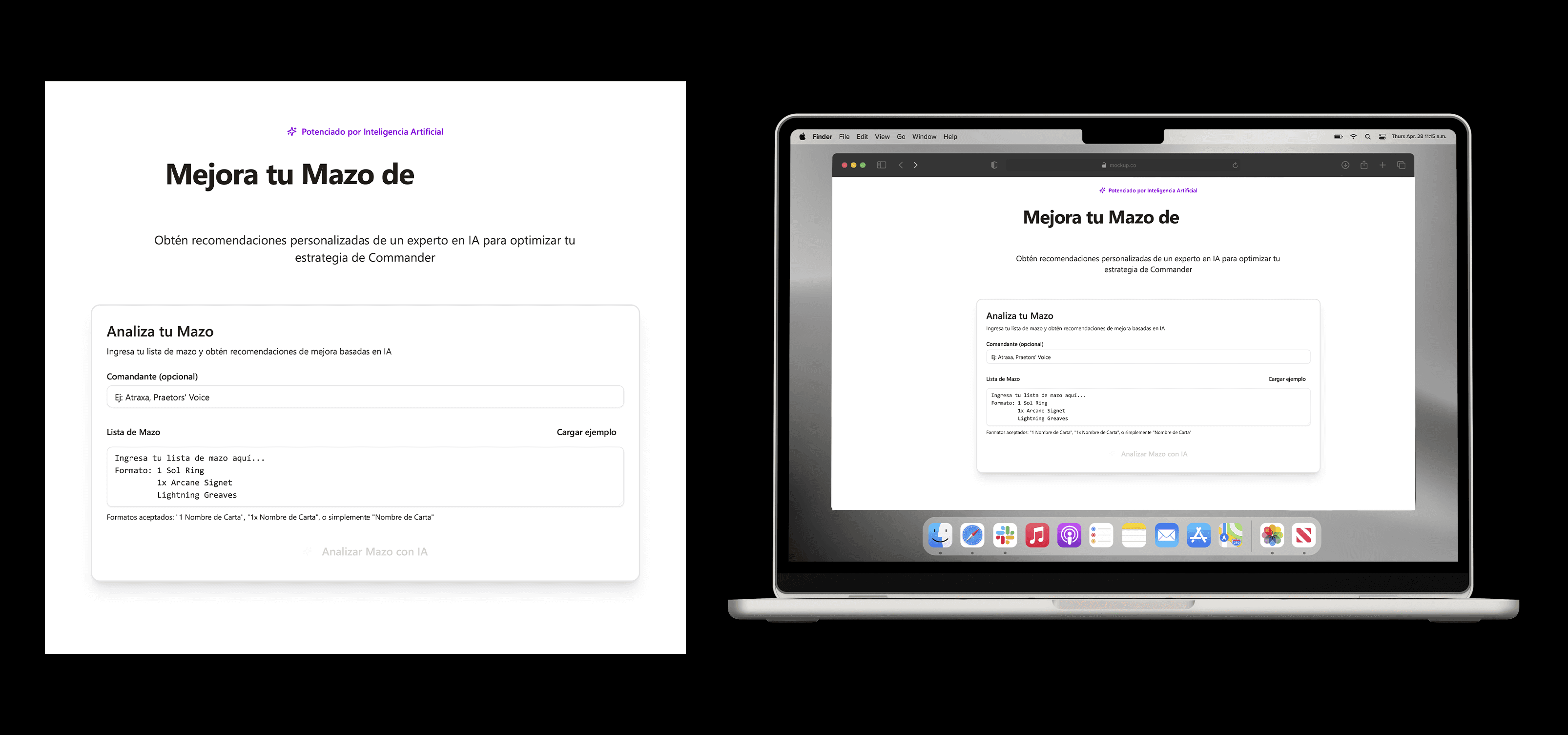
This result showed how powerful the AI is as a complete development partner. It could handle everything—from the website's look to the back-end logic and hosting—just from a simple text prompt. The key lesson here was that the AI is not just for writing content; it is a tool for building prototypes very quickly. The application automatically used Scryfall.com , a fan-made resource allowed by Wizards of the Coast, as the main source for card suggestions, which met my initial rule.
3. Test: Checking the Prototype
The website allowed me to enter a commander's name and the 99-card list and get a detailed analysis. This working website was the prototype. The testing phase involved trying different decklists to check:
•If it worked: Did the application correctly process the input and give me the four sections I asked for?
•If it was useful: Were the suggested cards good for the deck's main strategy?
•If it was easy to use: Was the website simple enough for a typical MTG player to use?
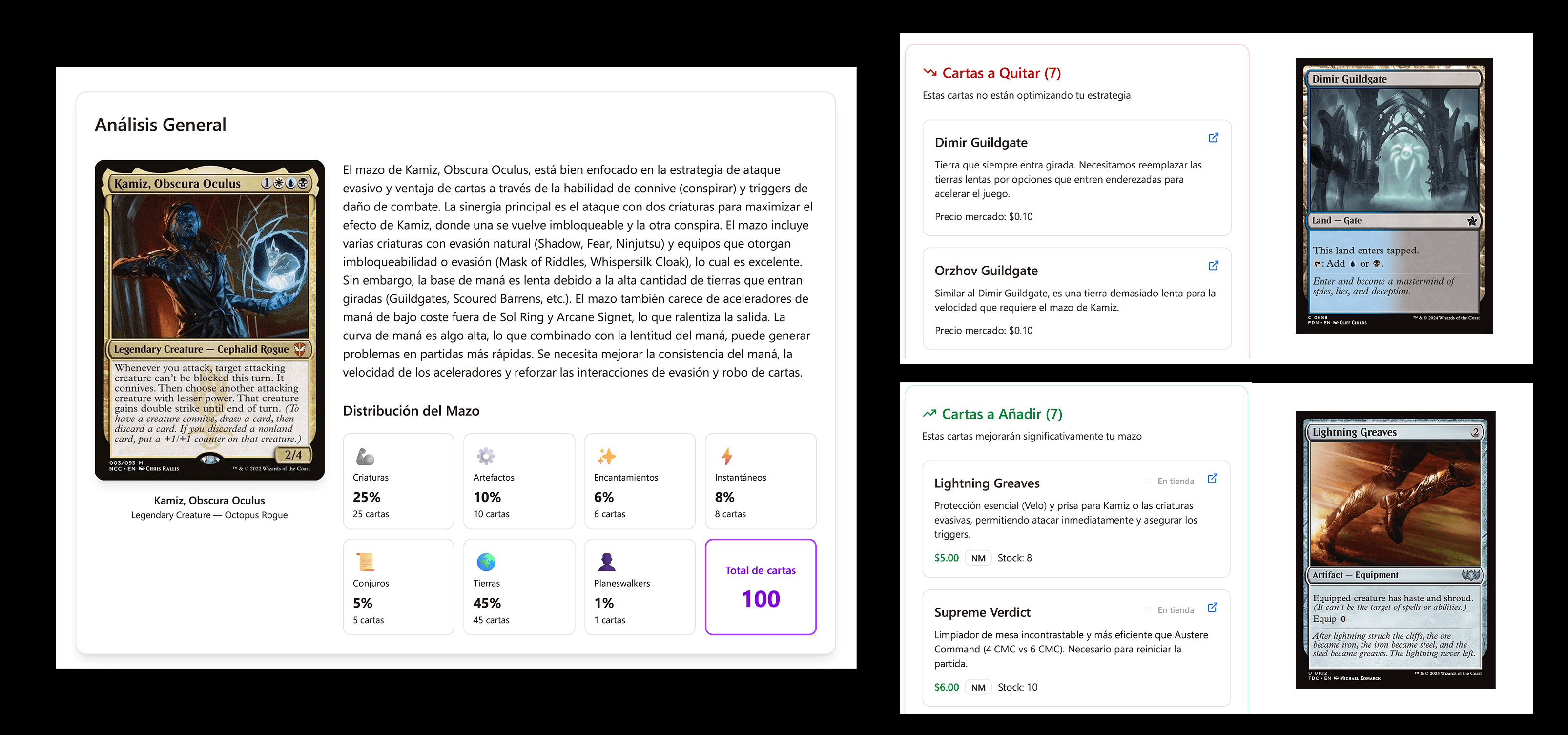
The first tests confirmed that the idea was good and that the AI-created solution worked well, giving me a strong base for future work.
4. Improve: Planning the Next Steps
The successful launch of the prototype immediately gave me a clear improvement plan. The "Improve" phase is ongoing and aims to turn this simple test into a strong, ready-to-use application. This means making the AI's analysis deeper, adding real-time card prices, and making the user interface better.
Conclusion: The Start of Beta 2.0
This project, which started from a personal challenge and was built quickly with AI, is more than just a working prototype; it is a starting point. The current version, built and checked quickly, is only the first step of a much bigger plan.
The success of this MVP proves that AI tools like Manus.im can greatly speed up the work of creative professionals. They allow us to go from an idea to a deployed application faster than ever before.
The next stage of development will focus on turning this test into Beta 2.0, which will include major improvements:
Feature | Current MVP (V1.0) | Planned Beta 2.0 Improvements |
|---|---|---|
Data | Simple link to Scryfall for card information. | Direct connection to Scryfall and other market data sites (e.g., TCGplayer) for real-time prices and availability. |
Analysis | General strategy, how cards work together, and weaknesses | More detailed information, like optimizing the mana curve, predicting win rates based on game data, and suggesting cheaper alternatives. |
User Experience | Simple text input and output. | User accounts, saved decklists, interactive card views, and a modern, easy-to-use design. |
Size | Simple prototype hosted on a temporary link. | Strong, scalable cloud system that can handle many users at once and has a permanent website address. |
This journey shows that the most important skill today is not just knowing how to code, but the ability to ask the right questions, plan, and check an idea using AI. This project is just the beginning of an exciting adventure, and I will share the progress of the MTG Deck Optimizer as it grows into a complete tool for the community. Stay tuned for the next development phase!